The Check Engine Light Just Came On? Here’s Why It Might Be a Software Glitch (Not a Breakdown)
A check engine light can make any drive feel uncertain. You may immediately picture a major engine failure, an expensive repair, or an unexpected tow. But on many modern vehicles, the light does not automatically mean a mechanical breakdown. Sometimes it reflects a software calibration issue, a communication error between control modules, or a temporary sensor reading that the vehicle’s computer interpreted as abnormal.
That does not mean you should ignore it. The check engine light is an important warning that deserves accurate testing. Professional car diagnostics in Bergen County can help determine whether the cause is a failing component, an electrical concern, or a software-related fault that may be resolved without unnecessary parts replacement.
Why modern vehicles can report software-related faults
Today’s vehicles rely on multiple electronic control modules. The engine control module monitors fuel delivery, ignition timing, emissions systems, air intake, exhaust performance, and many other functions. Other modules manage the transmission, battery, safety systems, climate controls, and vehicle communications.
These systems constantly exchange information over the vehicle’s communication network. The check engine light may come on when:
- A sensor reports a reading outside the computer’s programmed range
- Two control modules fail to communicate at the expected time
- An update changes how a system interprets normal operating data
- A battery replacement or voltage interruption disrupts module memory
- The vehicle’s software contains an overly sensitive diagnostic threshold
- A temporary fault is stored even though the component is now operating normally
In these situations, the warning is real, but the underlying issue may not be a broken engine part. The vehicle’s computer has detected something it does not understand or does not consider acceptable.
This is one reason modern diagnostics must go beyond plugging in a basic code reader and replacing the first part associated with a fault code.
A trouble code is a clue, not a complete diagnosis
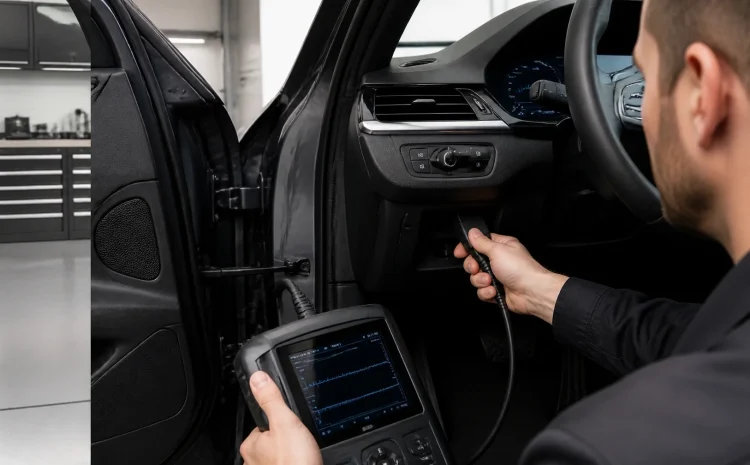
An OBD-II scanner retrieves diagnostic trouble codes, often called DTCs. These codes help identify the system that noticed a problem. They do not always identify the failed part.
For example, a code related to an oxygen sensor may result from:
- A genuinely defective oxygen sensor
- An air or exhaust leak
- A wiring or connector problem
- Low system voltage
- A fuel mixture issue
- Incorrect control-module calibration
Clearing the code without identifying the cause only turns off the warning temporarily. Replacing the sensor immediately may also waste money if the sensor was simply reporting a problem caused elsewhere.
A thorough diagnostic process combines the stored code with freeze-frame information, live sensor data, visual inspections, voltage tests, wiring checks, and vehicle-specific service information. The technician should also determine whether the vehicle has updated software, a technical service bulletin, or an open campaign related to the fault.
Three ways software can trigger a check engine light
1. Outdated or incorrect calibration
Manufacturers periodically update engine and transmission software to improve drivability, emissions control, fuel delivery, and communication between modules. If the original calibration is too sensitive or does not account for certain operating conditions, it may trigger a warning even when the hardware is functioning properly.
A software update may adjust the limits used to evaluate sensor readings or change how quickly the vehicle reacts to a temporary communication delay. Once the correct update is applied, the warning may stay off without replacing a thermostat, valve, sensor, or actuator.
2. Communication errors between modules
A modern European vehicle may have many modules communicating at once. If one module responds too slowly, loses voltage, or briefly drops off the network, another module may log a fault.
This can happen after:
- A weak battery or charging-system problem
- Battery replacement without the correct registration procedure
- A software update that did not complete correctly
- A loose ground or corroded electrical connection
- A temporary network interruption
The resulting warning may look serious, particularly if several dashboard messages appear at once. The correct repair may involve testing voltage and communication lines, resetting a module, or applying an approved software update. However, the technician must first confirm that the problem is not caused by a physical electrical failure.
3. False-positive fault logic
Diagnostic software uses programmed thresholds to decide when a reading represents a fault. If the threshold is too narrow, normal changes in temperature, fuel quality, driving conditions, or component movement can be interpreted as a failure.
This does not mean the warning is meaningless. It means the technician must understand how the vehicle’s software is designed to evaluate the system. A qualified European car specialist in Bergen County can compare the fault with manufacturer service information before recommending repairs.
What professional diagnostics should include
When you bring your vehicle to Cliffs Edge Automotive, accurate testing is the first step. Our computer diagnostics service is designed to identify the source of warning lights, drivability concerns, electrical faults, and performance changes.
A complete diagnostic evaluation may include:
- Full system scanning and fault-code retrieval
- Review of stored, pending, and history codes
- Freeze-frame data analysis
- Live-data monitoring during operation
- Battery and charging-system testing
- Inspection of sensors, connectors, wiring, and grounds
- Communication testing between control modules
- Review of applicable service information and software updates
- Road testing after repairs or reprogramming
This approach helps separate a software concern from a mechanical or electrical problem. It also supports a more transparent repair recommendation. Instead of guessing, you receive an explanation of what the vehicle reported, what testing confirmed, and what should happen next.

What to do when the light comes on
The type of warning matters.
If the light is solid
A solid check engine light often indicates that the vehicle has detected an emissions, sensor, communication, or performance issue. If the vehicle starts, drives normally, and has no other warning signs, you may be able to drive it carefully for a short time.
Still, schedule an inspection promptly. Delaying diagnosis can allow a small issue to affect fuel economy, emissions performance, or other components. A software glitch may be inexpensive to correct, but a real misfire, air leak, overheating concern, or fuel-system problem can become more costly if ignored.
If the light is flashing
A flashing check engine light requires more immediate attention. It may indicate an active misfire that can damage the catalytic converter or affect safe vehicle operation. Reduce driving, avoid heavy acceleration, and seek professional assistance as soon as possible.
Do not assume a flashing warning is only a software problem. Even when a software fault is eventually identified, the vehicle should be inspected before you continue driving normally.
Why European vehicles need specialized diagnostic knowledge
BMW, Mercedes-Benz, Audi, Porsche, and other European vehicles use sophisticated systems that may require brand-specific diagnostic software and procedures. Generic code readers can provide useful information, but they may not access every module or display the complete manufacturer-specific fault description.
A qualified luxury car mechanic in Bergen County understands that the same generic code can have different diagnostic procedures depending on the vehicle’s engine, model year, software version, and equipment package. Proper testing may also require:
- Manufacturer-specific scan access
- Module programming or adaptation procedures
- Battery registration after replacement
- Calibration of sensors and actuators
- Software-level verification
- Post-repair road testing and readiness checks
This is especially important when you own a vehicle designed around tightly integrated electronics. Replacing parts without confirming the root cause can create additional coding, calibration, or compatibility problems.
At Cliffs Edge Automotive, our team has more than 30 years of experience caring for European and domestic vehicles. We combine advanced diagnostic equipment with hands-on mechanical expertise and straightforward communication. You can learn more about our approach on our About Us page.
Do not panic, but do not ignore the warning
A check engine light is not a diagnosis. It is a request for investigation. In some cases, the repair may be a software update, module reset, or correction to an electrical connection. In others, the warning may identify a component that needs immediate attention.
The safest and most cost-effective path is to test the vehicle before replacing parts. Professional auto repair in Englewood Cliffs should give you a clear explanation of the problem, the available repair options, and the risks of waiting.
If your check engine light has appeared, schedule car diagnostics in Bergen County with Cliffs Edge Automotive. Our technicians can inspect the warning, verify whether software or hardware is involved, and help protect your vehicle’s reliability and long-term value. Book your appointment online or call 201-429-0165. We are located at 754 Sylvan Ave, Englewood Cliffs, NJ, and proudly serve drivers throughout Bergen County, including nearby Fort Lee and Alpine.